Laboratories

Laboratory1

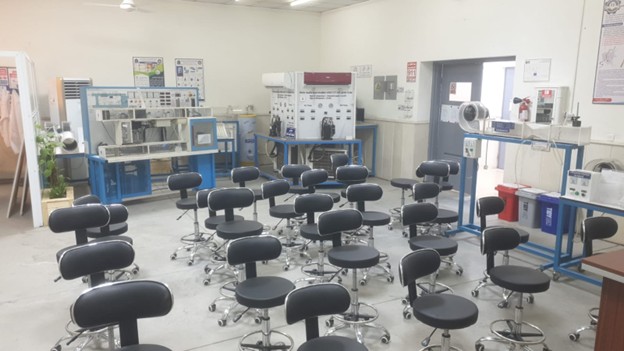
Air Conditioning Laboratory
Laboratory 2

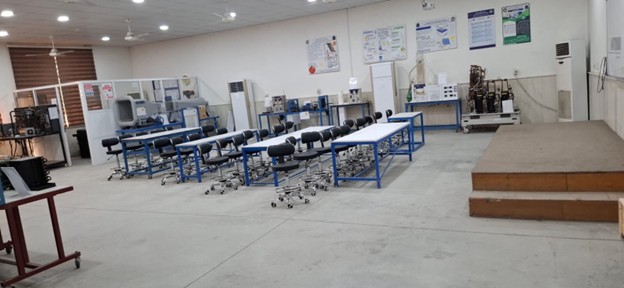
Refrigeration Laboratory
Laboratory 3

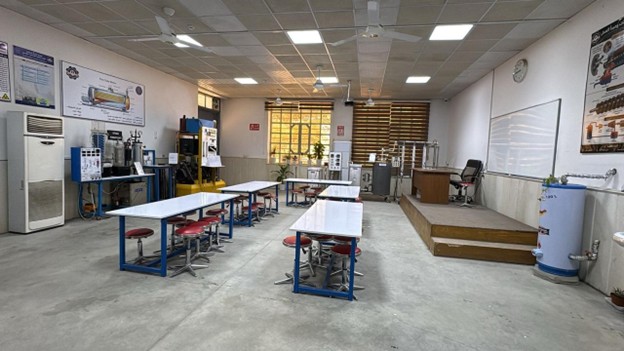
Thermodynamics Laboratory
Laboratory 4

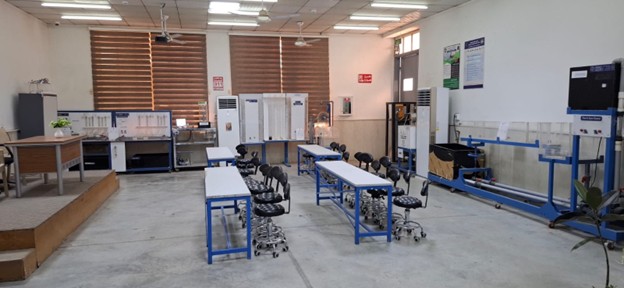
Fluid Mechanics Laboratory
Laboratory 5

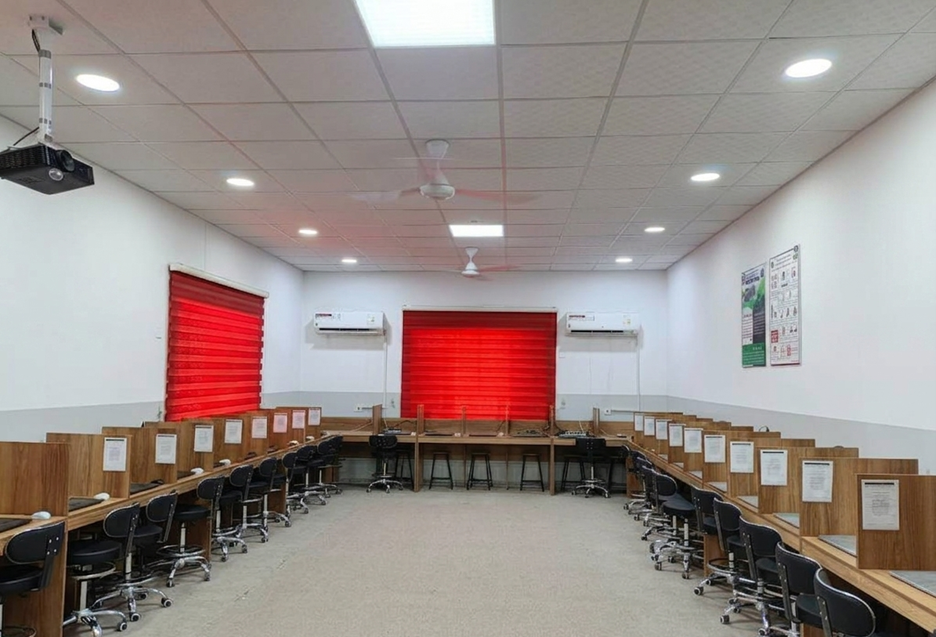
Computer Laboratory

Overview

The laboratories of the Department of Power Mechanics Engineering Technology represent a fundamental pillar supporting the educational process and scientific research, providing an integrated applied environment that enables students to apply theoretical knowledge in practical experiments simulating engineering applications in the fields of energy, thermal sciences, refrigeration, air conditioning, and renewable energy. The laboratories also contribute to developing students’ skills in measurement, analysis, operation, and fault diagnosis, preparing them to enter the labor market with competence and confidence.

First: Air Conditioning Laboratory

Laboratory Mission

To create a specialized educational environment that enables students to acquire knowledge and practical skills in operating and analyzing air conditioning and ventilation systems, linking theoretical concepts with modern engineering applications.

Laboratory Objectives

  • Identify the components of air conditioning systems and their operating mechanisms.
  • Study the properties of moist air and the use of the psychrometric chart.
  • Measure the performance of air conditioning systems and analyze their efficiency.
  • Develop students’ skills in operating and maintaining air conditioning equipment.

Key Experiments

  • Study of the air conditioning cycle.
  • Temperature and relative humidity measurements.
  • Use of the psychrometric chart.
  • Measurement of the thermal load of air conditioning systems.
  • Study of the performance of air conditioning units.


Second: Refrigeration Laboratory

Laboratory Mission

To prepare students to understand the practical principles of refrigeration and freezing systems through laboratory experiments that illustrate the performance of refrigeration cycles and their various components.

Laboratory Objectives

  • Identify the components of the vapor-compression refrigeration cycle.
  • Study the properties of refrigerants.
  • Measure the efficiency of refrigeration systems.
  • Develop skills in operating and maintaining refrigeration systems.

Key Experiments

  • The vapor-compression cycle.
  • Measurement of the coefficient of performance (COP).
  • Study of the evaporator and condenser.
  • Charging and recovering refrigerant.
  • Diagnosing common faults in refrigeration systems.


Third: Thermodynamics Laboratory

Laboratory Mission

To develop students’ applied skills in the field of steam systems and power plants through studying boiler operation, steam properties, and their engineering applications.

Laboratory Objectives

  • Identify the components of steam systems.
  • Study the properties of saturated and superheated steam.
  • Analyze the performance of steam boilers.
  • Develop measurement and operating skills in thermal systems.

Key Experiments

  • Operating the steam boiler.
  • Measuring boiler efficiency.
  • Studying steam properties.
  • Energy balance in steam systems.
  • Measuring fuel consumption and steam production.


Fourth: Fluid Mechanics Laboratory

Laboratory Mission

To develop students’ practical experience in studying fluid behavior and flow characteristics, and conducting laboratory measurements related to various hydraulic systems.

Laboratory Objectives

  • Study fluid properties and flow patterns.
  • Measure pressure and flow rate.
  • Analyze losses in pipes.
  • Study the performance of pumps and measuring instruments.

Key Experiments

  • Application of Bernoulli’s equation.
  • Measuring losses in pipes.
  • Studying laminar and turbulent flow.
  • Testing centrifugal pumps.
  • Calibrating flow measuring instruments.


Fifth: Computer Laboratory

Laboratory Mission

To create a modern educational environment that supports the use of engineering software in design, analysis, and simulation, contributing to the development of students’ digital and engineering skills.

Laboratory Objectives

  • Train students in the use of specialized engineering software.
  • Support practical courses and graduation projects.
  • Develop modeling and simulation skills.
  • Enhance the ability to analyze results and prepare technical reports.

Key Applications

  • Engineering drawing using AutoCAD.
  • 3D modeling using SolidWorks.
  • Engineering programming using MATLAB.
  • Thermal analysis using Engineering Equation Solver (EES).
Scroll to Top